Chapter-13
Tenure in Senior management level
After return from U.K. in December 1984 on completion of Sr MDP course I was again posted as ADRM/Danapur for a short period. It was now becoming apparent that my days of posting in the divisions were numbered and I should be mentally prepared to serve in the headquarters at Kolkata or the two divisions at Kolkata. Soon I was promoted on ad-hoc basis with posting as Addl Chief Engineer/Hqrs/Kolkata in 1985. As feared some senior appeared on the E. Rly from the outside and I had to be reverted. The GM (Sri H. Bandopadhyay ) said that I should now forget the divisions and stay at Kolkata as ADRM in the two divisions till I become senior enough to get promotion as Addl Chief Engineer on regular basis. This is how I was first posted as ADRM/Howrah .
ADRM (General), Howrah- The incumbent to this post had sought 2 months leave and I was posted in his place. Knowing my past assignments the DRM entrusted me mainly with staff matters and sometimes technical matter relating to engineering department. The parcel sidings below the DRM office were said to be the location from where the first passenger train in the eastern region had taken off. Construction of the Bankim Chandra setu (roadoverbridge) at the west end of the platforms and giving connectivity to the cab road, was completed in seventies after a long wait. However the piers and the girders of the old roadoverbridge still remained in their places which were an eyesore. These were subsequently dismantled and removed on priority basis, which considerably improved the appearance of the yard.
Today both the Eastern Rly and South Eastern Rly operate local, intermediate stations & long distance trains as under:- (a) Platforms 1 to 16 located in the old complex serve E.Rly trains. (b) Platforms 17 to 23 located in the new complex serve S.E.Rly trains. The cab roads exist between platforms 8-9 and 21-22 connected to Flyovers at the end of the platforms. Links- E.Rly and S.E.Rly sections are connected by (i) Liluah-Tikiapara link and (ii) Rajchandrapur-Dankuni-Maurigram link. There are 5 lines between Howrah & Liluah. Tikiapara coaching depot is one of the largest & oldest on the IR. Other coaching depots include the Sorting yard coaching depot and Jheel siding coaching depot.
Flooding of Howrah yard- In case of intense rainfall Howrah yard got flooded
as the local drainage system was overwhelmed.
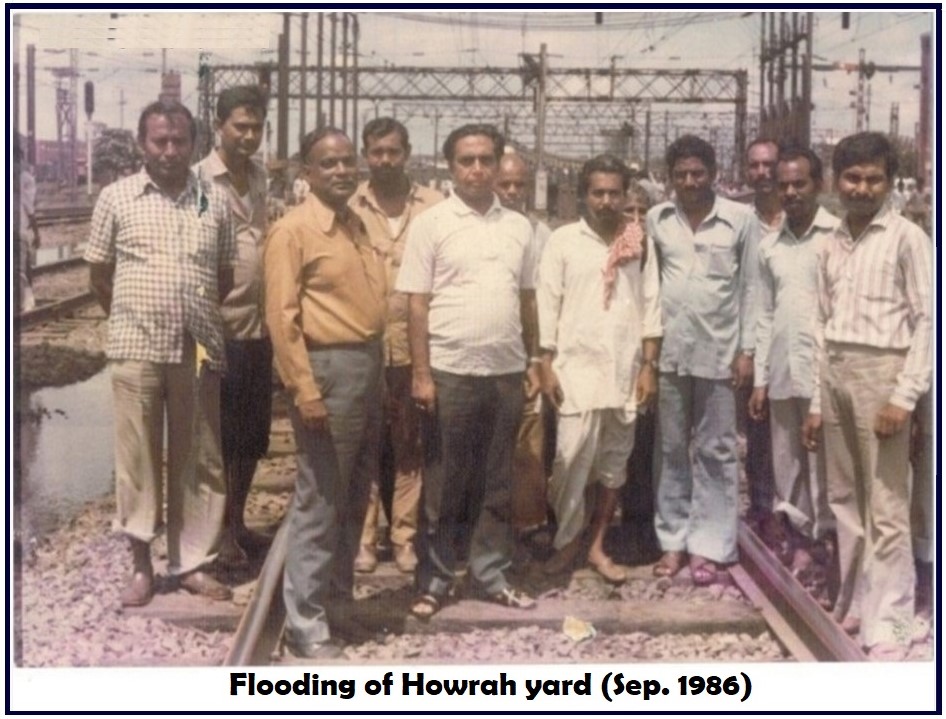
The water level in the Hooghly river temporarily rose high enough to admit the storm water drainage of the yard. Apprehending danger to the electrical gears of the EMU coaches due to excessive rise in water level, the rakes were withdrawn from Howrah yard and taken to safer places. This led to train delays, cancellations, and disruption to train services and causing great hardships to the commuters.
At one stage Howrah railway station faced threat to closure because the West Bengal Pollution Control Board (WBPCB) said that a huge volume of sewage from the station was discharged untreated into the Hooghly river. Today, however, the entire waste water generated at HWH station is treated in the Effluent Treatment Plant installed in the station complex.
I was once asked by the DRM to inspect a section in the Howrah-Bardhamman chord laid with Long welded rails resting on special types of sleepers. At Howrah station I told the accompanying DEN that I may be taking a nap in the train and he should awaken me when the train reached the station which he had named as ‘Majher Gram’. But when the train arrived at the destination station I found it to be differently named. The DEN cleared my doubts by stating that he actually meant ‘Belmuri’ station. But since naming the station aloud is rumoured to be a harbinger of bad luck , the railway passengers and the railwaymen use proxies.
ADRM(Technical), Sealdah- I had developed a liking for the post of ADRM/Howrah and wished to continue in it but it was apparent that the officer from whom I had taken over charge would revert to this post after expiry of his 2 months leave. To ascertain my prospect I decided to meet the GM (Sri H. Bandopadhyay). No sooner than I entered his chamber he told me: ‘Sahay, I know what for you have come. I have seen your service record and found out that you have in all the divisions of the Eastern railway except Sealdah. So I have decided to post you as ADRM/Sealdah. Enjoy this posting which in any case is going to be a short-lived in view of your impending promotion as Additional Chief Engineer.’ This is how I found myself in the corridors of Sealdah Division.
Geographically the division encompasses all the railway lines east of Hooghly, south of Lalgola and west of Bangladesh which were earlier under East Bengal Railway. The Sealdah Main (consisting of platforms 6,7,8,9,10,11,12,13 &14) handles long distance trains, Sealdah North (consisting of platforms 1,2,3,4 &5) primarily suburban trains and Sealdah South (consisting of platforms 15,16,17,18,19,20 &21) completely suburban trains. Links-The North and South sections have separate sets of emerging tracks, connected by (i) Kakurgachi-Park Circus link and (ii). Dumdum Jn-Majerhat link of the circular Railway. Prior to partition in 1947 trains used to run upto present day Bangladesh along Gede line and Bongaon line. Now Gede line is used by ‘Maitri Express’ upto Dhaka and Bongaon line by ‘Bandhan Express’ upto Khulna.
Kolkata Circular Railway (chakra rail) forming a “Dumdum Jn-Kolkata-Majerhat-Ballygunge-Park Circus-BidhanNagar-Dumdum Jn” loop comes under the jurisdiction of Sealdah division.
Chitpur, situated in the heartland of the city of Kolkata, has served as an important marshalling yard for around a century. It is interesting to note that with the passage of time there was decline in the activities of Chitpur yard and the new station complex of Kolkata has been developed in an area hitherto forming a part of this yard. Located in the alignment of the Kolkata Circular Railway, long distance trains originating from/terminating at Kolkata station are connected to the rest of the country via ‘Dankuni-Bally-Dumdum Jn-Sealdah’ Calcutta-Chord link line’ and ‘Sealdah-Naihati-Bandel branch line’.
The DRM was concerned with derailments in the busy Chitpur yard which had a very large spread and wanted me to improve the condition of the yard lines. This was important for satisfactory performance of the Division. My duty list also included periodical inspection of Sealdah Main & Sealdah South stations along with officials of other departments to ensure cleanliness and orderliness. I was ex-officio Rajbhasha Adhikary of the Division. Implementation of Hindi in official working for this division in Bengali heartland did not carry much sense. However the DRM found out a way to improve the division’s performance. He ordered that the officers should apply for casual leave only in Hindi. To facilitate their job cyclostyled leave application forms were made available to them in which only the dates and days were to be filled.
Headquarters posting--After some time my promotion order as Additional Chief Engineer was received from the Railway Board. But it was on the Central Railway. The GM said that if I would like to join the new place of posting he would have no objection. But if I was interested to stay on the Eastern railway, he would help me. On ascertaining that I would like to continue on the Eastern Railway he asked me to draft a letter justifying my retention. The Railway Board normally honours the wishes of the GM. This is how I was retained on the Eastern Railway. From 1985 to 1997 I served in the Eastern railway headquarters at Fairlie Place and at the New Koilaghat building at 14, strand road, Kolkata holding different posts.
Maharajpur- Sahebganj is a scenic town between hilly terrains and verdant landscape. Maharajpur - the station next to Sahebganj (coming from BGP) in Sahebganj-Barharwa section of Howrah division- is very close to the bank of Ganga. The river here swells during the monsoon and makes inroads into banks. Due to flooding in one monsoon season, there was large scale erosion of the south bank and the river course came dangerously close to the track. With the courtesy of the state government engineers we could have a boat ride in Ganga river both on the upstream and downstream of the affected site. It was decided in consultation with them that further onslaught of the river should be contained by constructing a series of spurs protruding into the river, in the vulnerable stretch.
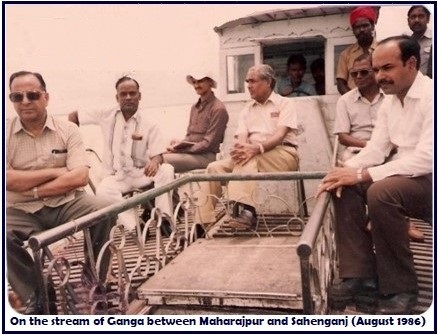
The building blocks for the spurs were boxes of sausages made of stone boulders packed in cover of wire mesh, which was lowered into the river. They were large and heavy enough to remain stable in the running water. This type of river training work behaved well and the bank could be protected. Since the work involved ‘hidden measurements’, the Finance and the Vigilance were taken into confidence by elaborate record keeping.
In fact, apprehending damage to the railway line near Maharajpur was visualized in the past and a retired alignment was already constructed over which the track could be linked at short notice in case of threat to the existing line. In subsequent years the bank was lined up with concrete tetrapods (4-legged structures interlocking with each other) to form a porous boundary.
Accident due to disregard of level crossing overhauling- As territorial HOD of Danapur Division I had to attend a passenger train accident. The Down Tinsukia Mail had come off rails at Dildarnagar level crossing due to multiple rail fracture. It was found that overhauling of this busy level crossing was deferred for an unduly long period because of ordeals involved in diversion of the road traffic. In consequence thereof the old rail had suffered fatigue and could no more stand the impact of the wheels. The responsibility was fixed on the engineering department. Since there was no casualty in this derailment the matter was not viewed very seriously. However it served as a lesson for the permanent way engineers to ensure overhauling of the level crossing in time despite hardships of arranging diversion/blocks of road traffic in collaboration with the state government officials.
Bank slip at Koelwar- This station is located on high banks at the west end approach of the the Sone bridge on Danapur division. During heavy rains the bank had slipped on the UP platform side disrupting the traffic. It was found that the rain water trapped between two high level platforms had no escape as the central drain was choked with ballast and muck due to neglect for a long time. The pore-water-pressure generated by seepage of this confined water adversely affected the soil-properties of the ill-kept bank causing slip. Fortunately the bank-slip was detected and the tracks protected in time. There was no mishap. Special courses at the IRICEN- During my service
 in the headquarters I had to attend various short term courses at this institute such as ‘Curves-speed ‘Mechanized laying & maintenance of track’, metallurgy of rail ’Formation- construction & rehabilitation’ , ‘Construction of prestressed concrete bridges etc. This also gave us an insight into various publications of this institute such as ‘Investigation of derailments, ‘Layout calculation’, ’rail steel & stresses’.
In one of the bridge courses we were shown a film on the construction of the modern London bridge (the third one) in 1973. The preamble of the tender document envisaged “ use of the best quality building material available in the market”. In one setting of the film a worker (an Indian) was seen doing pneumatic chiselling. The new bridge was inaugurated by the queen Elizabeth II with all the pomp and grandeur.
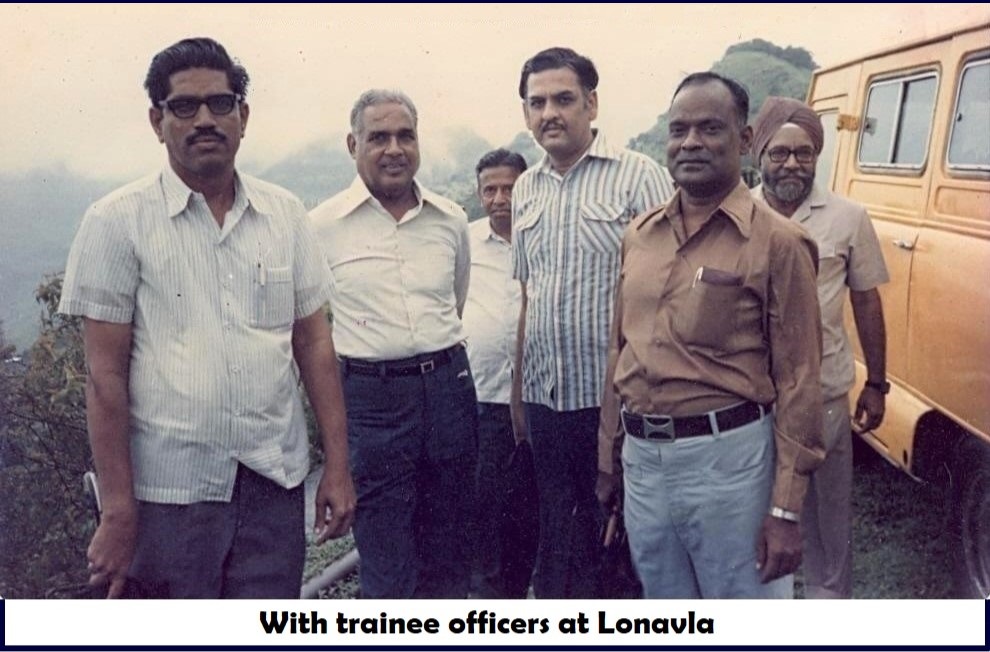
The IRICEN brought out a ‘Permanent Way Bulletin’ to which I, then CE(Survey), had contributed an article on ‘Longer transitions for higher speeds’ which was published in 1987. My batchmate M.Mani ,while as Professor at the IRICEN, had conceived the idea of making a cast-iron sleeper that could be made flat-bottomed by filling it with a mix of stone aggregate & bitumen. Such a sleeper resting on ballast would enable machine tamping and withstand stresses that would be generated. A test-track of a few rail-lengths was laid on Pune-Bombay line with CRS sanction. Mani wrote his experience as a thesis which was highly appreciated by Poona Engineering college and he was awarded Ph D. But with the passage of time , problems arose with the bitumen-mix fill not sticking to the inside of the plate after some rounds of packing. It was realized that there was need for improving the sticking quality of bitumen. However it was not pursued further.
Special courses at the Railway Staff College, Vadodara --In-service training at this premier railway institution was intended to cover subjects like ‘Discounted cash flow technique’, ‘Interpersonal & group skill development’, ‘Vigilance awareness’, ‘Dispute resolution & arbitration’ etc.

Such courses were useful in developing leadership & management , co-ordination , building relationships, enhancing skills and updating knowledge on computer.
Official residences- It all started with the occupation of the rest house at Howrah station followed by Transit accommodation at the same place. After waiting for my turn, I was allotted the Flat no 1D at new Alipur. It is a distinguished colony situated on the J.K.Paul road ,taking off from the Diamond Harbour road opposite the New Alipur mint.
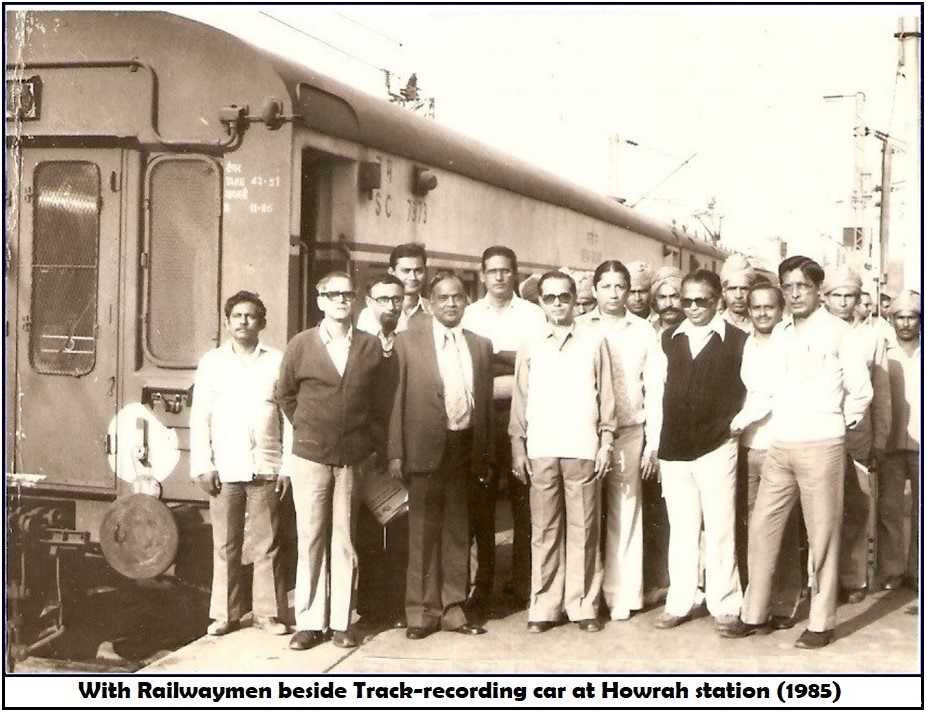
Test-track- A small length of test-track has been made at Howrah station for calibration of the Track Recording Car before start of the test-run.
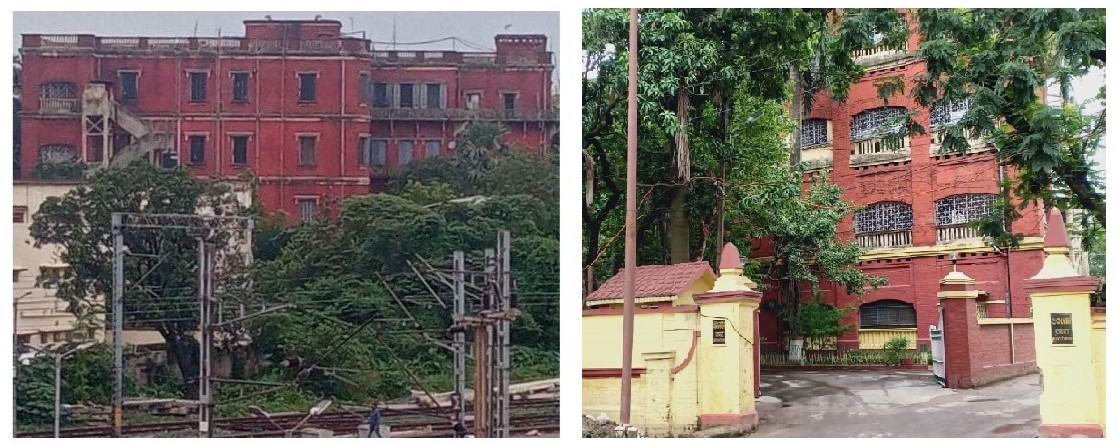
The Colvin Court- Due to some compulsions, I opted for a Flat at Howrah. This is how I shifted to 8, Colvin Court at Howrah. This red-oxide painted building situated on the right hand side of a train entering Howrah station compels the attention of the passengers because of its architectural manifestation. It was a prestigious housing for British India railway officers. We have fond memories of the view of the iconic Howrah bridge, the maze of Howrah yard lines and the famed orthopedic railway hospital from the roof top.
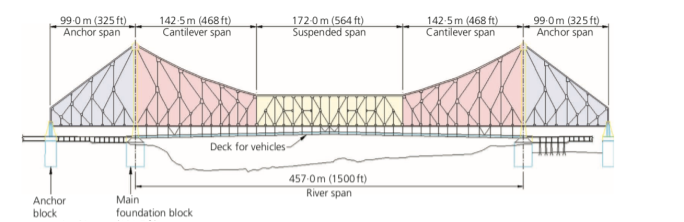
The Howrah bridge-Connecting commercial Kolkata with industrial Howrah ,this balanced cantilever bridge was opened on 3rd February 1943 ,in replacement of the pontoon bridge of 1874. Its span configuration is:- Cantilever arms (2 nos) @ 468 ft +Anchor arms (2 nos) @325 ft +Suspended arm @564 ft. ie Total length = 2150 ft. The first vehicle to cross over it was a solitary tram. The bridge was renamed as “ Ravindra Setu” on 14th of June 1965. The trams were stopped from using it in 1993 and the tram route was discontinued. The Setu is an architectural elegance and a spirited emblem of the city’s historic and cultural worth. The fabulous Mullick ghat flower market is situated directly under the shadow of the bridge on its east end. Many films have used it to evoke a sense of place, as a backdrop for long sequences and even as title.
Eastern Railway Headquarters at Kolkata—
The East India Company was founded in May 1855. R McDonald Stephenson was the
Managing Director of this company.The first Headquarters of the East Indian Railway was
At 29, Theatre road, Calcutta. It was shifted to its present location at Fairlie Place in 1879.
The present headquarters building was not so big and was having an
altogether different appearance.It was remodelled after the East Indian Railway
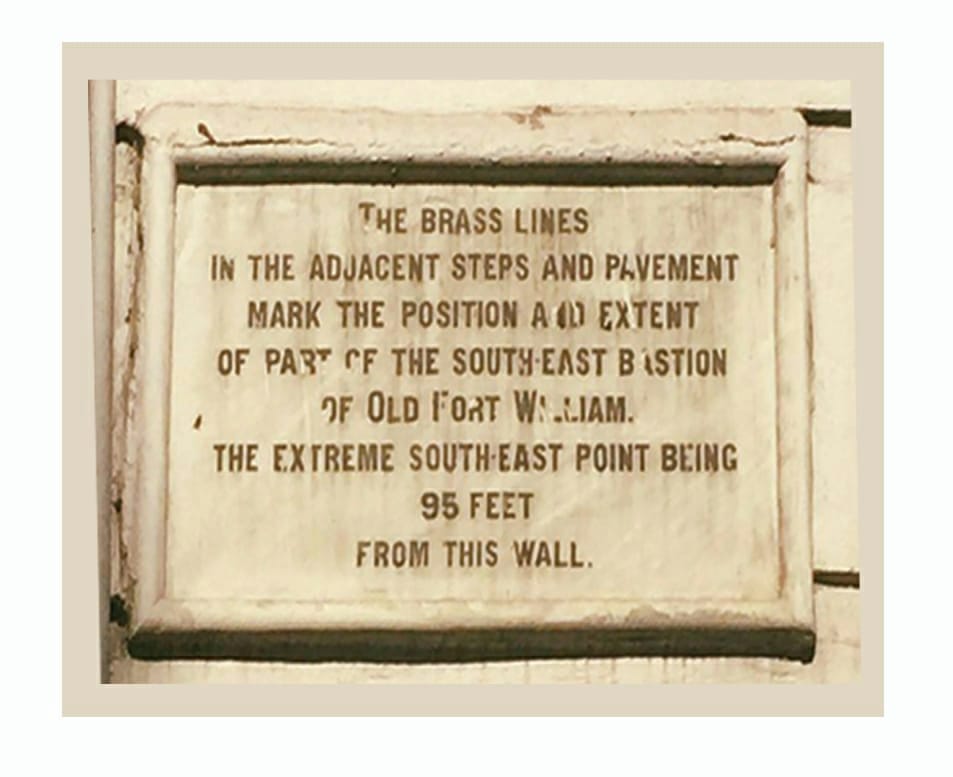
took over in 1879. Before being remodelled it was a part of the North-West Bastion
of the old Fort William.Plaques fixed on its premises bear testimony to it.

The Eastern Railway was formed on 14th April 1952 by integrating 4 divisions of the E.I.R. viz Sealdah, Howrah, Asansol & Dinapore and the entire Bengal Nagpur Railway. On 1st of August 1955 , however, the portion of the Bengal Nagpur Railway was separated from it and formed as South Eastern Railway, with its headquarters at Garden Reach,Calcutta.
The Eastern Railway Headquarters is housed in 3 separate buildings at Fairlie Place,
Old Koilaghat and New Koilaghat of which the first two are bestowed heritage status.
Fairlie Place is the main building containing offices of the GM & other HODs except
commercial department which is located at the old Koilaghat. The New Koilaghat is
the newest one consisting mainly of construction organization & reservation.
The grand edifice of the Eastern Railway headquarters is a structure celebrated
for its British architectural design since the colonial era. A steam locomotive
used on the Shantipur narrow gauge line of the E.Rly is plinthed near the portico.
The artistic mosaic work on the adjacent wall is entrancing. Framed photos of the
past General Managers are displayed on the wall of the conference room. A modest
Health unit equipped with wherewithal to deal routine cases is located on the
ground floor manned by a competent medical officer, which is well patronized.
Small food stalls on every floor serving Bread-Besan toast (a desi version of French
toast with savory and mild spicy flavour) was a common sight during lunch break.
For officers there is a lunch room. A cobbler was seen occupying a small space on
the ground floor,rendering valuable service to the staff.
The headquarters is abbreviated as CCC and its official address is 17, Netaji Subhash road ,Kolkata-700001 but popularly known as Fairlie Place (F.P.)

The Fairlie Place-It derived its name from a merchant called William Fairlie who was entrusted with the job of supplying and feeding the elephants and camels of the British army during the time of Lord Wellesley. Today the name Fairlie Place is synonymous not just with the street but with the iconic Railway building itself, a lasting symbol of the region’s rich historical tapestry. Fairlie Place Ghat close to the Eastern Railway. headquarters is a crucial embarkation point for ferries and boats that transport office-goers & visitors interested in exploring the city’s historic and cultural tapestry. Benoy-Badal-Dinesh Bagh (B.B.D. Bagh) named after freedom-fighters, is one of the central business districts of Kolkata. B.B.D. Bagh railway station of the Circular Railway, mostly used by the office-goers, serves Fairlie Place and local areas.
Some important features of working in the Headquarters
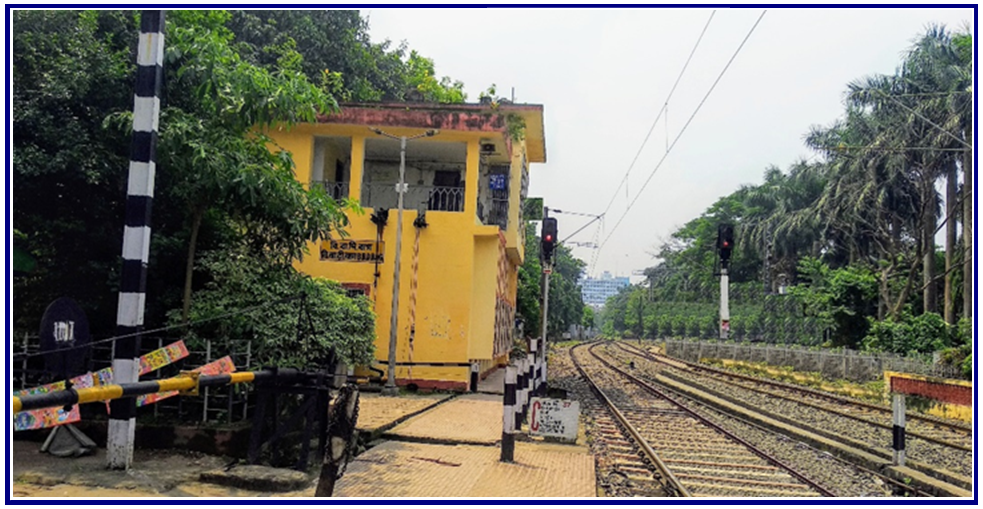
Indicator lamps- Senior officers have 2 aspect or 3 aspect indicator lamps outside their chambers. Red light signifies that the officer is busy. Green light means that he is available for discussion. For the GM and some HODs these indicators using semaphore signal lenses have been prominently hung from the verandah ceiling. GM and HODs have an yellow indicator also which implies that the officer is relaxing or is temporarily out. The aspect of light of GM’s indicator is repeated inside chamber of the HODs. Similarly, aspect of light of the HODs’ indicator is repeated inside chamber of the senior officers. The lights are manipulated by the secretary and PA.
Duty list-There is a duty list for every post which is revised from time to time. It is a good guidance to the officials and relied upon both for fixing responsibility as also for exonerating. Apart from functional duty the headquarters the engineering officers are entrusted with territorial jurisdiction also. On resumption of the charge of a post an official is supposed to go through his duty list carefully and regulate his actions accordingly.
Schedule of Power (SOP)- The booklet is published by the headquarters defining the power at different level of administration in financial matters, discipline & appeal cases, contract management and other miscellaneous matters. For engineering works of different values it specifies the authority to invite tenders, constitution of the tender committee, acceptance of the T.C. recommendations, signing of agreement etc. In any tender committee presence of a Finance member, normally one rank below that of the executive members, is a must. Seeking prior concurrence of the associated Finance is the requirement in many cases specially those entailing expenditure. That explains the rationale of spelling Finance with a capital letter. The SOP is revised periodically to take into account the delegation of powers and the element of inflation. Since procurement of stores is centralized in the stores department the executives have limited power in purchase of materials. However considering the technical nature and need for timely procurement the engineers have been permitted to procure track fittings at their own level. This has however cast added responsibility on the engineers, hitherto accustomed to work contracts ie supply and fixing.
Daily incident report- A central control room functions at the headquarters where staff drawn from different departments sit in 8 hours roster. They collect information from the divisions and other field units about accidents, train detention, rail failure, water supply disruption, mob agitation, staff agitation etc. The materials so compiled are typed after 08.00 hours, cyclostyled and are placed on the officers’ table at about 10.00 hours. Before we settle down for the day’s work, we go through the Incident report, get the feedback from the divisional officers and gear up ourselves for facing the colleagues from other departments as well as the Railway Board officials.
No-tour day- Monday is designated as no-tour day when all the officers are expected to stay in the headquarters except for emergency.
No-meeting day- Monday is also regarded as no-meeting day. However mini intra-departmental meetings do take place for discussing routine matters.
Silence hours- 10.00 to 11.00 hours is assigned as silence hour. It is expected that no officer will make a phone call in this period except for emergency and even not call subordinates to his chamber.
The files- It had a correspondence side containing received and dispatched letters serially numbered. Then there was noting side containing note sheets serially numbered. Words like ‘sir’, ‘yours faithfully’ etc., have no place in the noting. On the top of a file there was movement slip which was required to be filled in while remitting the file to other.
Tour programme - For any official movement one has to submit tour programme for information of the controlling officer. For movements outside jurisdiction prior permission is generally required.
HOD meeting – It takes place once a month attended to by the HODs and DRMs and chaired by the GM. Progress of on-going works are, inter alia, discussed which spells anxious moments for engineers. They are closely questioned for bursting the target dates of completion (TDC) and asked to indicate the revised TDC, only to be further revised in the next meeting.
Parliamentary questions- Reply thereto are approved by an officer not below the rank of Senior Administrative Grade.
Roster duty- Before Durga Puja vacation the officers have to indicate the dates on which they would be available in the headquarters. Thereafter a roster is formed in a way that at least a couple of them attended the office every day during the vacation.
Works Programme meeting- It takes place once a year at the Railway Board in which the GM accompanied by the HODs participate. Normally a First AC coach was attached to Poorva Express for accommodation of the HODs. Staff are also booked for carrying papers and assisting. The physical as well as financial progress of the on-going works are discussed by the full Board. The new works proposed by the Railway are also gone into and decision taken about their inclusion in the next rail budget.
Pink book – it is a book containing details of works, machinery and rolling stock programme included in the budget for the coming financial year. It derives its name because of pink cover provided on it. For each work (both ongoing and new), it contains the following information.
Work wise sanctioned cost and the allocations.
Expenditure at the end of March of the previous year
Outlay for the coming year
Balance outlay to complete
Inspection carriages- What people call as ‘saloon’ is actually inspection car. Its use is limited in the following senses:
-
It is pooled except for the General Manager, Addl GM, Chief Operations Manager and the Chief Mechanical Engineer. As regards Engineering department there is a pooled carriage for the Chief Engineer, Chief Engineer (Con) and the Commissioner of Railway safety.
-
Booking of the inspection carriages is allowed between stations where shunting pilot is available. Shunting by train engine is not allowed.
-
Except for the inspection carriage of the GM no other carriage is air-conditioned.
-
Attachment of carriages is barred in certain premier trains.
-
There is an observation car (CE 2), with trailing windows which is at the disposal of the Chief Engineer.
-
An Officer can take an outsider in his inspection carriage provided he is in possession of a first class/ equivalent ticket.
-
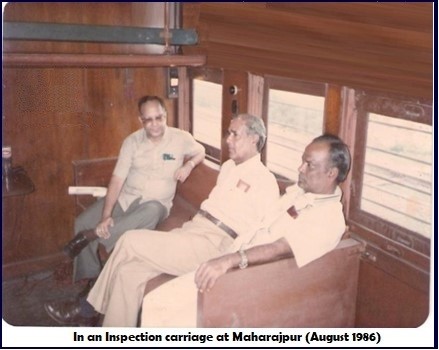
The inspection carriages have windows on one of the rear sides only. If the orientation of the carriage is such that the windows are the rearmost, opening towards the track it is called trailing window and is looked for by the engineers for observing track behavior during the run of the train. A carriage may go in this position from Howrah to Mughalsarai. But if similar facility is desired in the return trip also the carriage will have to be turned through 180 degrees on a turntable at Mughalsarai.
Chief Engineer (Survey)/Eastern railway- It was for the longest period (1987-1992). The office was at the New Koilaghat building at 14 Strand road. I was assisted by a Dy COPS survey, The surveys assigned to the Railway were Engineering -cum -Traffic survey with the purpose of finding out the technical feasibility of a project (new line, doubling, yard remodeling, replacement of an important bridge etc.) , its cost and the benefits. The Rate of Return (ROR) would be calculated by the Discounted Cash Flow (DCF) technique. Taking into account the dividend payable to the General Revenue, the depreciation and contingency a ROR of about 10 percent was looked for. But such a figure was unattainable. The survey report after vetting of the Financial Advisor and approval of the General Manager would be sent to the Railway Board. The Railway had to comment specifically whether it considers the project worthy of implementation. In view of poor ROR outright recommendation was not possible. We however always commented that the railway Board may consider sanctioning the project on developmental consideration. Two surveys are memorable:
Survey for a rail bridge over river Ganga at Patna—Mr J.M.Fenton as Deputy Chief Engineer of the East Indian Railway had in the year 1947 conducted this survey. His survey report is historic. The site surveyed by him was subsequently termed as Fenton site for future reference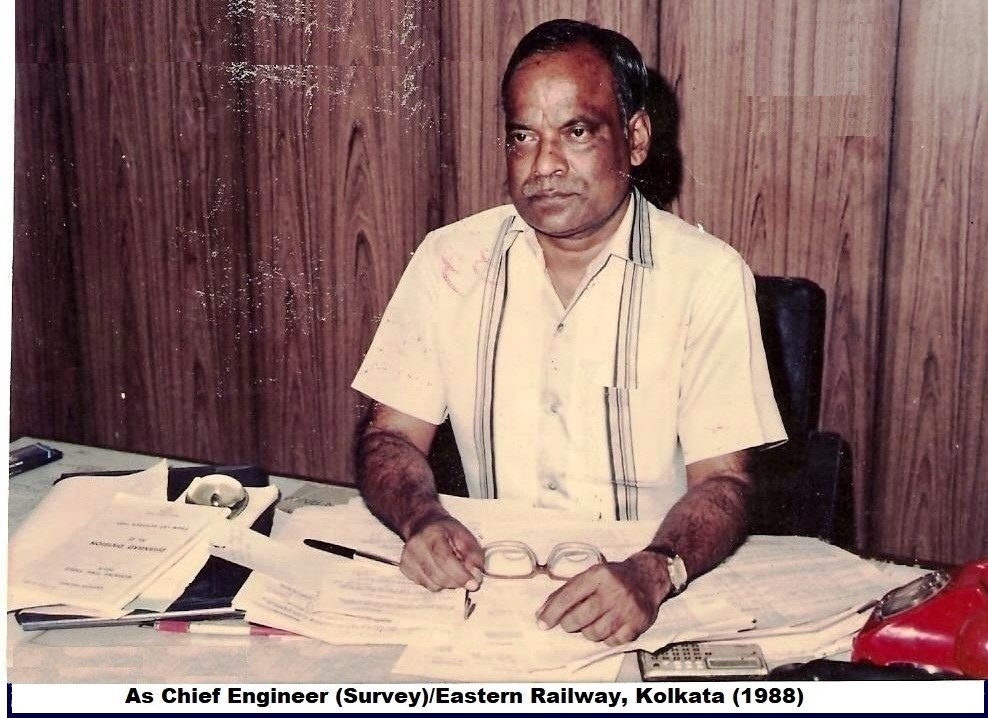 It is nearly the same where the present Digha bridge has been built. He could not, however, recommend its construction as it would pose threat to city of Patna situated on its south bank. Another survey was carried out by Sri V.C.A. Padmanabhan. A committee of experts from the Railway, its technical wing (Research, Design & Standard Organization), Ministry of water resources and State Govt examined these reports followed by model study at the Central Water power research station(CWPRS), Pune and narrowed down their choice to two sites viz the Fenton site and the other on the downstream of Mahatma Gandhi road bridge. Considering the former as potential threat to the city of Patna they finally recommended engineering-cum-traffic survey of the latter. This was the survey allotted to the Eastern Railway. The survey report was prepared and sent to the Railway Board with copy to the State Government of Bihar. This survey had generated great interest in the political circle. The then Chief Minister was unhappy with the report and desired that the engineer of the Eastern Railway who prepared this report should see him .This is how I found myself at Patna accompanying the Honourable Chief Minister and his team of officers on the bank of Ganga at Patna. He stopped at a place, which appeared to me as the Fenton site, and said that it was the location where he would like the bridge to come up. He assured of all the help (ferry, helicopter) in conduct of the survey. I returned to Kolkata and apprised the GM of the development. It called for a fresh model study. When I visited Pune to find out if the structure of the old model study still existed. It did not. Satellite imageries were procured. They could serve as guide but were no substitute for model study. Today we all know fresh model studies and fresh survey were conducted and the political consideration prevailed upon technical one. The rail cum road bridge has finally appeared at the Fenton site and is standing well for the last 4 years.
Survey for Ara-Sasaram new B.G. line—Following closure of the Ara-Sasaram light Railway in 1978 a survey was sanctioned for construction of a new broad gauge line in its place. The survey was conducted in eighties. But because of poor financial remunerativeness the project was not sanctioned. After several representation, the reappraisal of the survey was sanctioned which devolved on me. I was happy as I was emotionally attached to this area since my school days. The Honourable Minister of Railways arrived at Ara station to lay the foundation stone for this survey. I accompanied the GM to Ara (my hometown) at this occasion. The GM was not very enthusiastic thinking that this project with possible poor ROR may not ever see the light of the day. Anyway, the survey was taken in right earnest. I was not happy with the alignment but since it was a reappraisal a fresh survey on a new alignment was not possible. The Survey report was submitted after I was transferred from this post. As apprehended the report did not bring out bright prospect but the Honourable Minister blessed it.
With the blessings of the GM, I succeeded in outsourcing Engineering-cum-traffic surveys on ‘Howrah coaching terminal’, ‘Sealdah coaching terminal’, ’12 coach EMUs’,’ Reconstruction of the Jubilee bridge between Bandel & Naihati, and ’Reconstruction of the Upper Sone bridge’ to the RITES on single tender basis. The outcome was satisfactory.
I used to receive many letters from influential persons addressed to the General Manager seeking construction of new lines. In case such a survey was done in the past I had to give a stereotyped reply stating that the survey was carried out in the past and because of financial unremunerativeness the project could not be sanctioned. The survey for a rail line between Barwadih and Chirmiri has a history behind it. It was conducted during British Raj and the project was sanctioned on the consideration that it would link two mineral rich areas as also reduce the distance between Bombay and Calcutta by about 400 kms. Even the construction work started in early forties but abandoned before Independence. An acquaintance of mine who hailed from Daltonganj mentioned to me that he had seen the remnants of bridge substructure, service buildings and staff quarters in Barwadih-Balrampur section. In the meantime construction of rail line from Chirmiri to Ambikapur was completed and opened for public traffic. Thus a length between Ambikapur and Barwadih remained which was sanctioned in 2013. However it was starved of funds. Reportedly the task of preparing a DPR on its feasibility and economic viability has been entrusted to Chhatisgarh Rail Nigam Ltd.
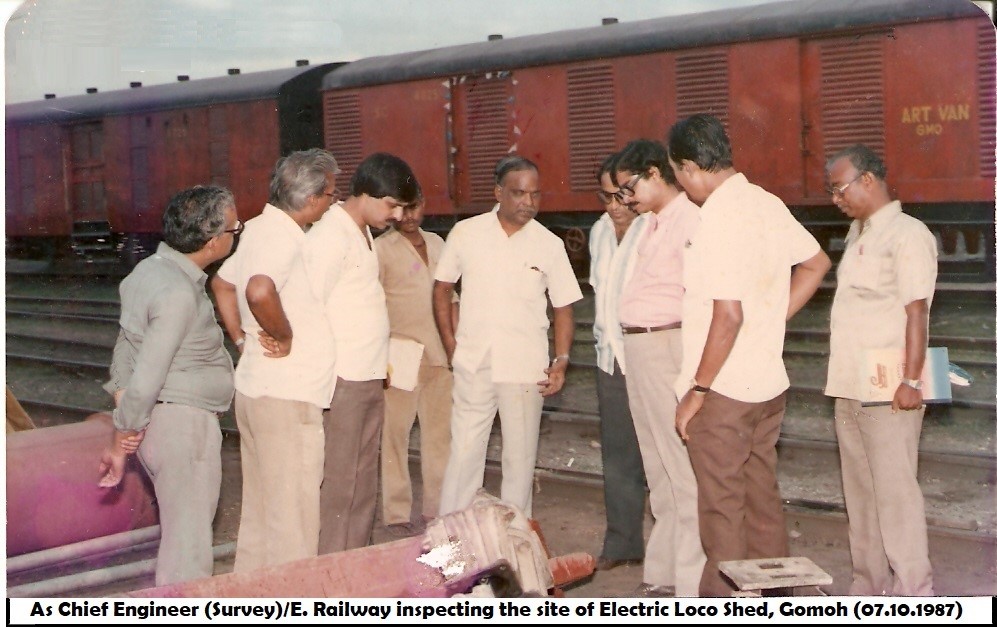
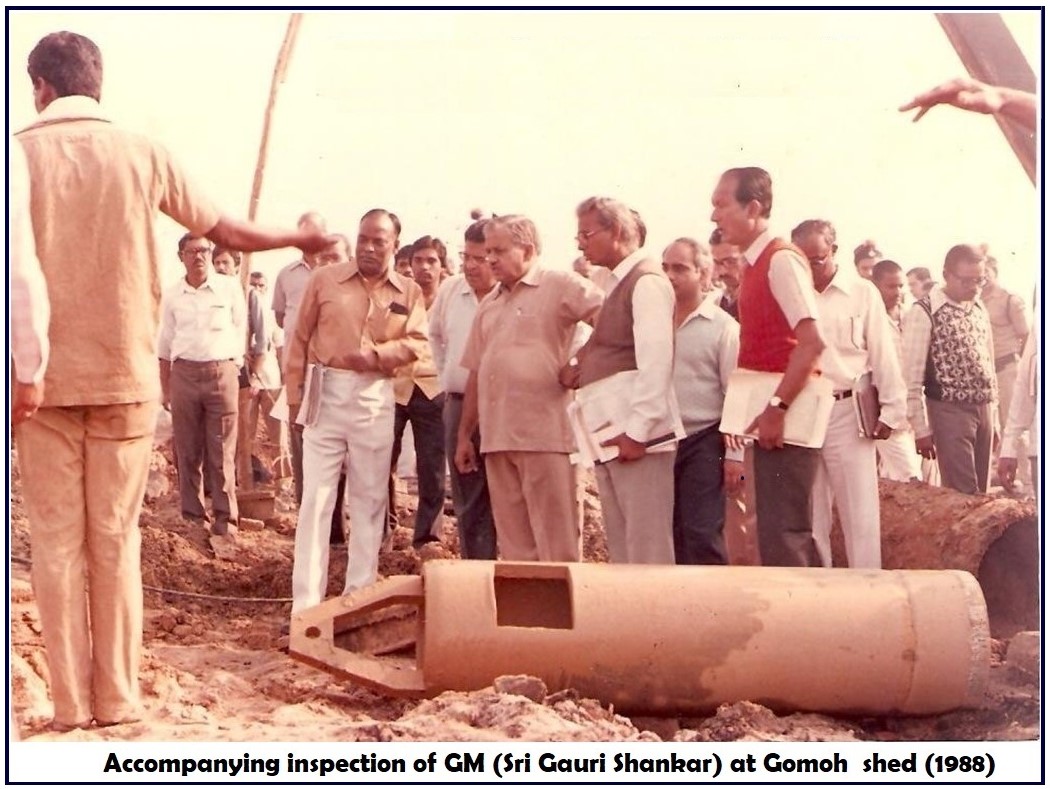
I was in charge of construction works in Dhanbad division also. The steam loco shed at Gomoh was destined to extinction. A new electric loco shed was to appear in its place. I was distressed to author dismantling of the steam loco shed which I had nursed as AEN 20 years back. ‘Barwadih-wagon POH depot’ was a prestigious work. Other important projects included ‘Phusro-Jarangdih diversion’, ‘Danea-Kedla siding’ and ‘KD-Heslong siding’ – all Deposit works of the Central Coalfield Limited. They were all bogged down awaiting complete land acquisition.
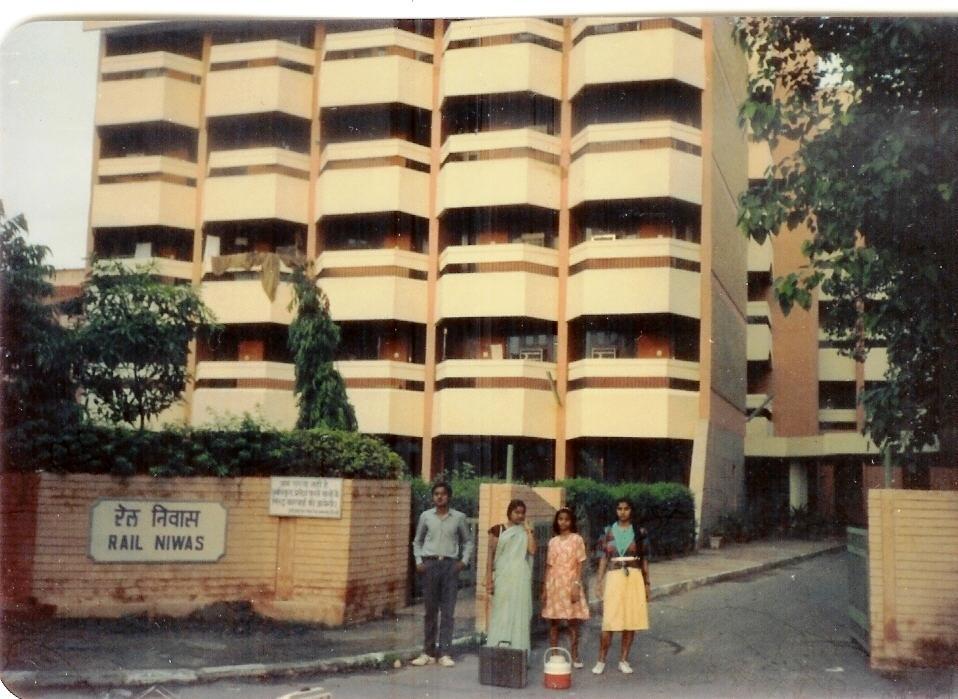
For attending meetings at the Railway Board, we generally stayed in the Rail-Nivas at the State Entry road. Some 4 suites were allotted to the Eastern Railway. The booking was done by the Eastern Rly headquarters for their officials proceeding to New Delhi for official purpose.
While in this post I found time to visit the Topchanchi lake near Gomoh. It was a solace that nothing was done in this period which could mar the panorama of the cluster of trees of Sal, Siris, Mahua, the sublimity of the hills ,the placidity of the lake or pulchritude of the surrounding.
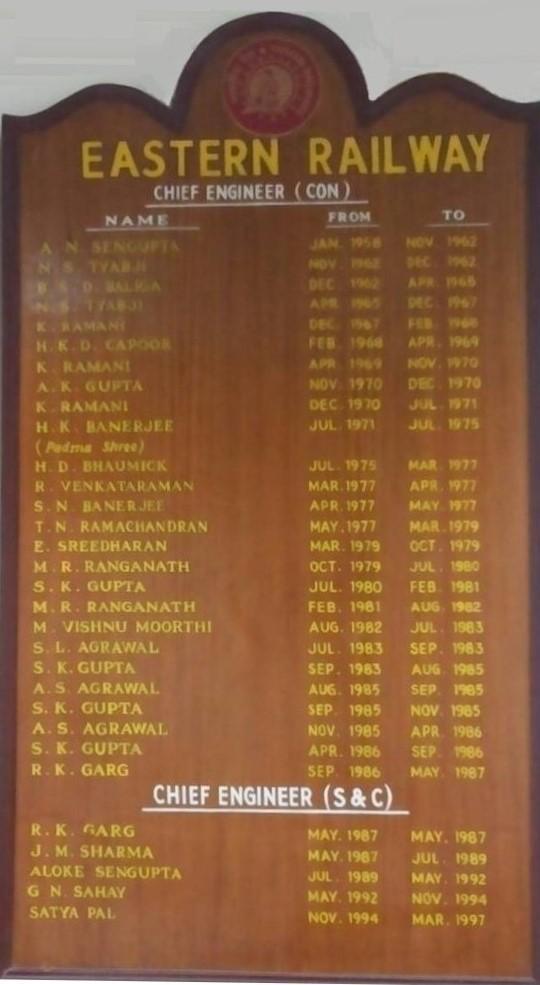
Chief Engineer (Survey & Construction) from 1992 to 1994 -- I took over charge of this post from Sri Alok Sengupta under whom I had worked as Chief Engineer (Survey) for about 3 years. It makes an interesting reading that his Father also held the post of Chief Engineer (Con)/E. Rly and his name appears at the top of the incumbency board displayed hereunder. The office continued to be at the New Koilaghat building at 14 Strand road. Some of the important projects were Lakshmikantpur-Namkhana new rail line, Malda town-New Farakka doubling, SoneNagar-Garhwa road doubling, Bhagalpur-Jamalpur doubling , Andal wagons POH shed, Asansol coaching complex, Barwadih wagons POH shed, SoneNagar flyover (for unobstructed passage of the Down Grand Chord trains to the CIC section popularly known as Barkakana loop)
At Shaktigarh station the Down H-B chord trains cross the path of Up and Down H-B Main trains leading to detention of trains. To overcome it a flyover at Shaktigarh was sanctioned . There was a long-drawn-out debate whether it should be single-line or double-line.
Another problem which defied solution for a long time was finalizing the scheme for construction of the missing link of the Kolkata Circular railway between Prinsep ghat and Majerhat ,because of objections from the Customs department.
In the monthly review meeting in the conference room of the Fairlie Place, progress of all the on-going works were discussed and target dates of completion fixed. Wherever these dates were exceeded a satisfactory explanation had to be given and a fresh date proposed. The number of revisions sought was duly recorded in the minutes of the meeting to corner us in the next meeting. While proposing the next revised date of completion I used to be confident of honouring it. But the time would fly past and another embarrassing moment awaited me in the next meeting. Sri Ashok Bhatnagar GM one day reminded me that in the interest of the work ,CE (Con) sometimes called on DOS/Howrah ( perhaps he himself) to facilitate grant of blocks and that I should not hesitate in such moves. Since the review meeting was attended to by the CSTE(Con) and CEE (Con) also, we used to have our internal meeting ahead of the meeting with GM to avoid embarrassing moments. The CME used to have separate meeting on works related to workshops and sheds attended to by a territorial CE(Con). It was also necessary to read the pulse of FA & CAO(Con) on matters (Draft paras, Completion reports ..) which may invite displeasure of the GM. Sometimes GM discussed progress of the works separately with the territorial CE(Con) in his chamber. Monthly meeting in the Railway Board used to be with the Executive Director (Works) and the minutes jointly signed.
After ascertaining budgetary provision from the ‘Pink-Book’ received in the month of March, we had to devote substantial time in creation of work-charged posts within the ambit of the Detailed Estimate and the yardsticks for creation of different categories of posts. It was necessary that this exercise was completed before 1st of June. Preparation and processing of voluminous ‘Detailed Estimate’ took months. During this period the expenditure was met by obtaining sanction to a 2-page Urgency Certificate.
Tender & contract :-
One General Manager (a Civil Engineer) took extraordinary interest in the progress of the works and meticulously went through the news of Eastern Railway tenders. This I found out when one day he phoned me to elicit additional information. I was caught unaware. From that day I was careful to keep myself informed with publication of my tenders.
As shortage of technical staff was realized we resorted to ‘Tender for calling tender’ ie tenders were invited for ‘ Preparation of design, drawing and Bill of quantities’ in respect of bridges & structures, based on which further tenders were processed.
‘Short-listing’ of the contractors for specific nature of works (earthwork, bridges. tunnel, shed…) was practised. But it was time-consuming process. ‘Two-packet’ system of tendering had not yet firmed up.
Since engineers have limited powers in respect of supply contracts, we used to convert them into work (ie Supply & fixing) contracts by introducing a small element of labour. It was not that the Finance did not perceive it.
The tendered rates were sought to be justified by comparing them with the Last Accepted Rate (LAR) for similar nature of work ,with due weightage for escalation between the date of opening of the two tenders, assumed @ about 10 percent per annum. For remaining items Analysis of Rate was done taking into account elements of material, labour, machinery & plant & consumables. The contractor’s profit was taken as 12.5 percent in accordance with the Analysis of Rate of the Eastern railway.
Implementation of ‘Risk & cost’ clause in respect of rescinded contracts was not a facile job. Fresh tender had to be invited on 2 sets of schedule (i) for Risk & Cost items and (ii) for remaining items. The failed contractor was specially invited to participate in it. It was surprising that at times he did participate knowing fully well that the extra expenditure in operation of the new contract will be recovered from his bills. With introduction of ‘Performance Guarantee’ clause in present day contracts this anomaly has been set at rest.
Shri Ashok Sengupta my batchmate had joined as the CRS (Commissioner of Railway Safety), Eastern circle, Kolkata. Officially I had to approach him for joint inspection of the newly created assets by me (doubling, new line, new crossing station) and according approval for passenger opening thereof. This was in accordance with the railway rules and the CRS’ sanction came after the formality of inspection. But the difficult part was to hand over these assets to the open line for maintenance.


Sunderban railway project—Sunderban delta formed from the sediments of Ganga, Brahmputra and Meghna rivers is ,in reality, a mosaic of islands perennially sculpted by brackish water surging in and around endless labyrinth of water channels. It is accredited sssssssswith the world’s largest contiguous Mangrove forest and home to Royal Bengal tigers. For extending the railway line deep into it and promote new growth area , construction of a new rail line from Lakshmikantpur to Namkhana (47 kms) was sanctioned. It was the occasion of opening of the first section from Lakshmikantpur to Kulpi. The Railway Minister wanted the section to be inaugurated by a local influential leader of his party which was resented to by the leaders of the party ruling the state. It was a trying time for us cajoling the local leaders while inviting them for the function.
The Circular Railway --It is a point of interest for the visitors and a boon to the commuters. running under Ravindra Setu, Vidyasagar Setu, parallel to the Hooghly river and through commercial establishments & administrative offices it fascinates its users with the scenic views of the iconic buildings, the historic ghats, the bridges and the riverside. A portion of this project from Dumdum Jn to Prinsep Ghat was already commissioned but its further extension to connect Majerhat was beset with problem because of customs-bounded area in its alignment. Happily, this problem was subsequently resolved by constructing a viaduct through the restricted area. Now the line is fully operational between Dumdum Jn, where it is an interchange point with the metro station and Majerhat.
Bolpur (Shantiniketan)-The local influential public representative took extraordinary interest in the railway affairs and was keen on doubling of Vardhamman-Shantiniketan section. One day a tree plantation ceremony was arranged on the vacant land on the east side of the station. I remember to have planted a sapling of ‘Bakul’. This is destined to bear a dense canopy of small shiny leaves & flowers with a delightful fragrance. Bakul is an evergreen tree symbolizing growth, resilience and beauty. Planting it was a symbolic act of leaving a positive imprint in the railway premises. I am thrilled to see it flourish and represent the values I hold dear.
Budgetary reviews - After voting of the Demand for Grants by the Parliament, Appropriation bill is introduced to provide for appropriation of funds to meet the expenditure. After it is passed, the Railway Board allot funds to each railway unit through budget order. During a financial year, three budgetary reviews are submitted by the railways with the objective of review the progress of expenditure vis-a-vis allotment. These are made in the forms of August Review, Revised Estimate-cum- budget estimate and Final Modification and submitted to the Railway Board for redistribution of funds ,if necessary.
MCDO (Monthly confidential demi official letters)- It was required to be sent once a month to the Member Engineering ,addressed as Secretary (Works), enlisting the performance during the month , the shortfalls with reason and help, if any, needed from the Railway Board. In practice, however, it was the Executive Director (Works) who mattered for us. The progress review meeting at the Railway Board was generally held with him and the minutes jointly signed. The Member Engineering could hardly spare time for such purpose.
Railway Users Consultative Committee – Frequent opportunities are provided to the rail users at the Railway Board level (NRUCC), Zonal level (ZRUCC) and Divisional level (DRUCC) to solicit their views on improving the efficiency and quality of rail services. I attended two ZRUCC (Zonal Railway Users Consultative Committee) meetings. After discussing the outcome of the suggestions made by the members in the last meeting, fresh suggestions were invited, which were noted by the Railway.
Conference of CE(S&C)--I had the privilege of attending such conferences at Surajkund (Delhi), Nandi hill (Bengaluru), Research, Design & Standards Organization (Lucknow). In one conference of the CE (Con)s at the Eastern Railway headquarters at Fairlie Place ,Kolkata Sri Y.P.Anand (Member, Engineering) was addressing us. He narrated his experience of his visit to an Officers’ rest house. There was a dome provided in the lounge, but it was covered with cloth. The conversation between Sri Anand and the engineers went on like this.
Sri Anand------Why have you provided a dome here?
The engineer- Sir, so that it should look good.
Sri Anand- ----Okay, then why have covered it?
The engineer- Sir, so that it should not look bad.
Sri Anand further added ‘the bathroom had an array of fittings. I could not make out which fitting to turn which way and if at all water comes it will be hot or cold. At one stage I nearly escaped scald injury.’ Referring to his residence office he said, ‘We provide windows in our house so that light and air come and then cover them with curtains so that light and air do not come. We provide lamps in our house so that good light is available for reading, Then we cover them with shades so that only dim light comes. I have four lamps in my residence office, but I cannot read the files.’
The visit to Guwahati happened by chance. We were accompanying inspection of the Railway Minister from Mughalsarai. On reaching Barauni -a station on the N.E.Rly- we presumed that our presence was not required further. But the Minister desired that we continue our journey and make ourselves available for the meeting the next morning at Guwahati where he was to inaugurate the Rajdhani express. Though unprepared for this development I was happy to get an opportunity to meet Sri Mihir Dev Varma (then Sr DGM) who was with me in England in 1984 and also my ex colleague Sri Sharat Kumar Sinha, posted in the N.F.Rly headquarters at Guwahati.
Lumding-Badarpur mountain Railway is a spectacular section with a stunning charm. The train passes through lush green landscape and tunnels & viaducts that span fearsome deep ravines. This 225 km line, which the British took 11 years and Rs 4.2 crore to complete in December 1903, is an engineering marvel and yearns for heritage status.


Republic day celebration- On such occasions I received invitation from the Raj Bhawan (through our railway headquarters) for attending dinner along with my family members. A sticker was also provided for display on the official car to facilitate entry. It used to be a large gathering of important persons from the Legislative, Executive and Judiciary. The Governor and the Chief Minister were available for exchange of pleasantries from the invitees.
There was another change of post for me as I was appointed as Chief Engineer (West) in August 1994 to which I remained till superannuation.
Sri H Bandopadhyay, GM--The Secretary (Sri S.P. Biswas) entered his chamber to find him engulfed in gloom. Secretary-"what is the matter Sir? It appears something is worrying you." GM-" Yes, it is one Income-tax commissioner who is making my life miserable. Surprisingly he looks very much like you." Secretary-" Sir, cheer up. He is my brother. He will not trouble you any further." On the day of superannuation of Sri Bandopadhya we assembled in his chamber at about 6 p.m. exchanging pleasantries till 06.30 p.m. he did not appear relaxed and kept on disposing files till the last moment.
The largesse of railway service--As a welfare measure Eastern railway has created rest houses for group A and B staff as well as Holiday homes for group C and D staff at important hill stations and other places of importance. These are made available to the staff on payment of token sum of money. However, the rest house at hill stations are in great demand during summer. Hence one is required to arrange booking in time. If one approaches in the month of March they will say “too early”. In the month of April, it will be deemed “too late”. Arranging Rest-house accommodation at outstations & train reservation was very convenient from the headquarters .I availed of this bounty to visit many places.
The Eastern railway rest house at Puri faces the sea beach. In fact, one gate provided on its boundary wall opens towards the sea. Because of regular visitors from Calcutta there was a railway staff easily available to help the officials in visiting the holy shrine. A trip to the south was designed to cover Marina sea beach, Rameshwaram shrine, Vivekanand rock memorial, Meenakshi temple and Padmanabhswamy temple. Rest house accommodation at Chennai, Rameshwaram, Kanyakumari, Maduri and Tiruananthpuram was arranged with the courtesy of my batchmates on the Southern Rly. A small charge is payable by the serving railway employees occupying the railway rest house while not on duty.
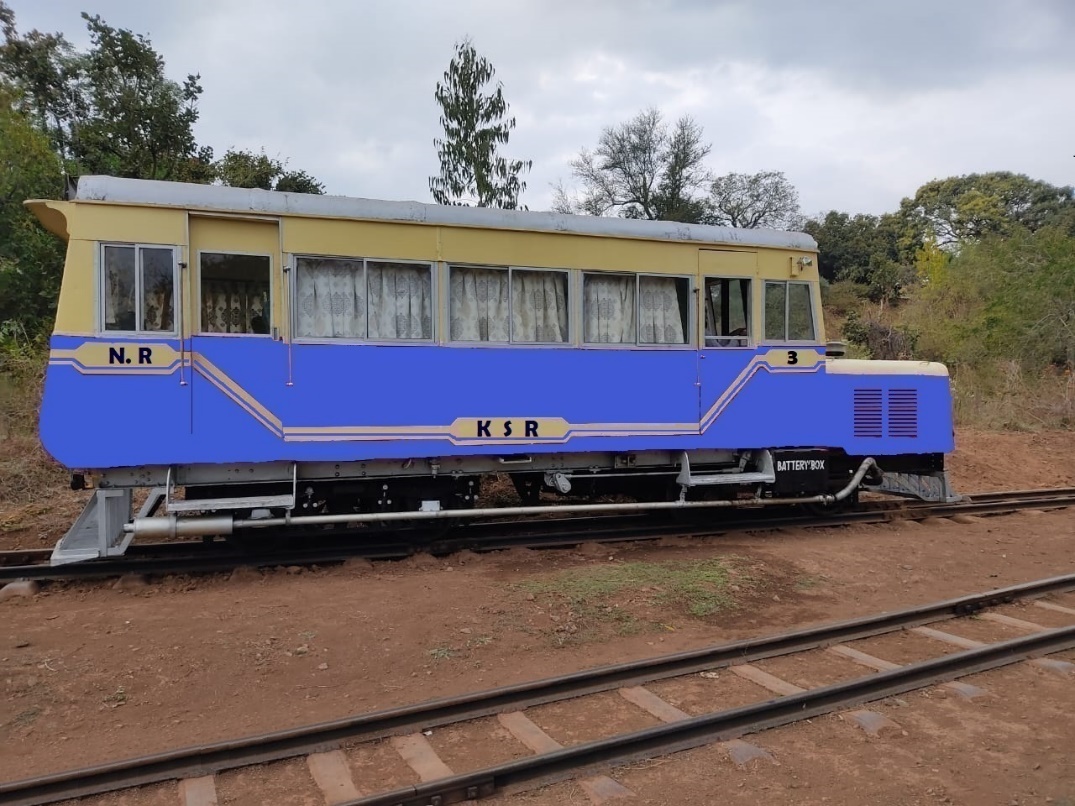
Shimla- The summer capital of the British Imperialists and the present capital of Himachal Pradesh is a city in the dense forest of Himalays. On arrival at Kalka station by the Howrah-Delhi-Kalka mail I found that a narrow gauge (2 feet 6 inches gauge) train with a diesel loco attached to it was waiting on the adjacent line for our onward journey to Shimla. Laying track on the arduous slope of Shivalik hills that too in hostile conditions ,120 years ago ,the Kalka-Shimla Railway is the finest example of narrow gauge railway engineering skill. It is tribute to both men and the mountains. Opened during British regime in 1903 it is today a UNESCO world heritage site.
it so happened that while the train was on its way the keyman had detected a rail fracture ahead of it. As a result the train was stopped in the mid section awaiting repair to the track.

The journey was resumed after substantial loss of journey time. Solan is a charming station with 2 platforms. After traversing a number of tunnels and bridges the train arrived at Barog where it stopped for over 10 minutes to enable the passengers to have their snacks. The portal of the Barog tunnel and the starter signal was visible at the far edge of the platform. Taradevi railway station, nestled in the foothills of the Himalayas, offers stunning views of the surrounding mountains. The name derives from Mata Tara Devi temple situated near this station. The third longest tunnel (No.91) at 992 metres is situated on the Shimla end of this station. The mountainous route of 96 kms abounding in tunnels, bridges and viaducts offered a dramatic view of the hills interspersed with Deodars, Pine and Oak trees as well as the surrounding hamlets.
Shimla Railway station has a majestic glory.

There was a Rail car named “Shivalik’. Its fate is unknown. New version of Rail cars have appeared.
Pedestrian-friendly Mall road and the Ridge are the leading hangout place and shopping centres at Shimla.
The old Railway Board building at Shimla :- There are many heritage and colonial structures at Shimla. One of the finest example of such structures is the Railway Board building close to the Mall. A plaque erected thereon testifies that this unique building was built in 1896-97 by a Bombay based Firm (Richardson & Cruddas) at a modest sum of about Rs 4 lakhs only. This required demolition of the old residences known as “Herbert House” and “Lowville” which were initially rented and subsequently acquired by the government to house the Railway Board and other offices. The elegant structure above the road level has four levels and three basements ,with one side exposed climbing down the hill. Constructed at a time when safety was a paramount consideration for eminent buildings in whole of the British empire, this astonishing construction of cast iron, glass and steel was designed to be fire-resistant. This was affirmed in the aftermath of the fire which struck the top floor of the building in 2001.

The damage caused thereby was fixed and the original features were restored by the engineers with meticulous care. Even after the incidence of the fire Its facade is as imperial today as it was a century ago. Greatly impressed by this masterpiece some important government offices were subsequently built adopting the essence of its architectural and structural attributes. No wonder that the Railway Board building today attracts those pursuing a course in architecture in reputed institutions.
Haridwar, Rishikesh & Mussorie- Ganga first descends on the plains at Haridwar (the gateway to Gods) held in esteem for its temples & Ashrams. Kumbh mela is a significant event celebrated every 12 years at Haridwar during which pilgrims, devotees and tourists congregate in large number for ritual bathing. Rishikesh, considered as ‘Yoga & meditation capital of the world’ , is a major tourist & pilgrimage centre. We had visited these twin cities and the ‘Queen of hills’ Mussorie years back. Hence they had faded from our memories. Haridwar-The day began with a holy dip in the cold and fast flowing water at the famous landmark namely Har-ki-Paudi ( the steps of Lord Vishnu). But we were careful to hold the protective chains to prevent being swept away in this process. The main river is not preferred by the devotees because of the high velocity of the flow. For their benefit an escape channel has been dug over which Ganga water flows through Har ki Paudi at a moderate velocity. Cycle rickshaw is a popular mode of transport and was seen in good number on the streets of Haridwar thronged by locals, devotees and cows. Restaurants and dhabas in the city excelled in vegetarian food, some employing a chotiwalla, with a balding head sporting a vertical ramrod- straight tuft of hair, to attract the customers. A sensory spectacle awaited us in the evening at Har ki Paudi where people had assembled to witness ‘Aarti’ performed with flaming torches, ringing bells and chants. The devotees also floated earthen lamps with burning flickers placed on leaves and flowers to the water stream. These presented a spectacular sight to behold for rest of the life. Sadly the serenity and spirituality of the occasion was marred to some extent due to pestering by some fellows insisting on performing puja and asking donations.
Rishikesh- The iconic cable suspension bridge (Lakshaman Jhula ) at Rishikesh compels our attention. During my college days the professor while teaching design of cable suspension bridge had mentioned Lakshaman Jhula. According to him the bridge structure was frail and hence elephants were not allowed over it. He further added that parades are not allowed to march over it with steps in unison. As in such a situation the frequency generated may match with that of the bridge’s natural frequency of vibration causing resonance and endangering the bridge structure. A 13 storey high temple located on the other side, on the bank of sacred Ganga attracts the attention of the visitors. The rail link to Rishikesh, only 22 kms from Haridwar, takes off from Raiwala junction.
Last time I had visited Mussoorie in June 1975 when it was a family of four only photographed in traditional dresses. The younger daughter had since joined the family and she was thrilled at this trip. This time also we put up in the same railway rest house. The mission to the above three was accomplished at a stretch with Haridwar as base.
Rajsthan- Colour symbolism in Rajsthan dress has subtle significance. To add a tinge of colour and life to the parched, colourless landscape and the uninspiring cloudless skies ,the people of Rajsthan show a discrete preference for bright costumes. The state abounds in affluent colours, the sparkle of mirror, silver & valuable stones, the shimer of silk and expressive kaleidoscope of cotton. The fantastic and distinctly colourful , Rajsthan is synonymous with elegant forts, stately palaces, lakes ,sand dunes, camels and people dressed in radiantly coloured costumes.

Rajsthan has meted out ,one should always remember, the gift of state in folk music and instruments. Talented musicians in traditional attire and colourful turban, wielding primitive looking ‘Bow & string’ instruments, weave peace and calmness with their soulful music and mysterious stories of religious beliefs and experiences of life.
The tour designed to cover Agra, Jaipur, Ajmer and Udaipur opened with visit to Agra. We detrained at Tundla Junction to see Taj Mahal and Fatehpur Sikri by road. After visiting Agra Fort we caught the train for Jaipur from the adjacent station of the same name . ‘Chokhi Dhani’, a little away from the city of Jaipur, is a theme village which mirrors the culture, food traditions and heritage of Rajsthan. A little overpriced entry fee included food and some freebies. We were treated to dinner in Rajsthani style. The seating arrangement was on floor mat. Delectable traditional multi-cuisine food was served on leaf plater by the natives in Rajsthani costume in an ambience of Manuhaar (beseeching) . There were also shows & performances (Ghoomar dance) in hut shelters illuminated by lanterns and bullock cart ride. Further journey to Ajmer and Udaipur was by road. Pushkar lake (about 14 kms from Ajmer) is a sacred spot for Hindus. Pushkar Mela , an annual livestock fair and cultural fete held in the month of Kartik (late October-early November) is a great attraction for domestic and foreign tourists. Udaipur enamours the visitors with its elegant “City Palace”, picturesque “Sahelion ki Badi” and sublime “ Fatehsagar lake.“ My erstwhile colleague on the E. Railway who had since taken over as DRM/Jaipur was kind enough to arrange rest house accommodation at Jaipur, Ajmer and Udaipur.
Visit to Aizwal- The state of Mizoram derives its name from the word “Mizo” which is the self-described name of the natives and “Ram” which stands for land . Earlier a district of Assam, it became a Union Territory in the year 1972 and attained statehood in 1987. Since then it has experienced peace and steady progress. The state occupies an area of great strategic importance in that it shares its border with Bangladesh and Mymmar also. A very large proportion of the land area is forested. Agriculture is the dominant economic activity. Literacy rate is very high.
It was about one hour flight on a Dornier (18 seater) plane from Kolkata airport to Aizwal airfield. The city is about 25 kms from there.
Mizoram and railway --Reasons for sparse Rail network in the eastern Himalaya are as below:
(i) Geographical reasons- presence of big rivers, dissected plateau, dense forests , frequent floods, landslides and international frontiers present difficulties in laying railway lines.
(ii) Historic reason- Fear of influx of migrants which may restrain the interest of indigenous communities.
However there was belated realization that for the state to develop it must have rail network. Bairabi became the railhead of Mizoram when it was rail-linked to Katakhal (on Badarpur-Silchar section of the N.F. Rly) in 2016. Construction of Bairabi-Sairang new railway line (53 kms) is under way and likely to be completed in 2025. From Sairang station Aizwal, the capital town of Mizoram ,is only 20 kms. Completion of the proposed rail connectivity project will lead to transformation of this state through better transportation.
Tour of Goa- The small state of Goa in Konkan region, was annexed by India in 1961 and incorporated as Union Territory. It was granted statehood in 1987. The Portuguese rule of about 450 years has greatly influenced its culture, cuisine and architecture. Konkan is the official language but Hindi is understood by almost everyone and spoken by many. The state is famous for its beaches. Tourism forms backbone of the state economy but the tourists are generally with limited means. The people are hopeful that changes could be effected which would attract upscale demographic. The activists and environmentalists had opposed construction of the Konkan Railway passing through Vasco da Gama. As a result the alignment passes through Madgaon and Madgaon-Vasco da Gama remains as a spur.
Because of disruption of rail traffic on account of gauge conversion in Miraj-Vasco Da Gama section the journey between Mumbai and Goa was performed as under:
(i) Outward journey- Mumbai to Goa by bus in an overnight service. Alternatively Hovercraft service was also available.
(ii) Return journey -From Panaji to Belgaum by bus. That the bus was negotiating an escarpment rising from the sea coast to the Western ghat mountain, was palpable. Belgaum to Miraj by a passenger train. Miraj to Mumbai CST by Mahalaxmi Express.
We also availed opportunities of short distance tours from Kolkata
Shantiniketan (Abode of peace):-
Gurudev had founded a school here modelled on the lines of ancient Gurukul system. After he received Nobel prize the prestige of the school was enhanced and the school was expanded to a university. To enable the Gurudev to remain cozy during his wait at Bolpur (Shaniniketan) station the Railway had provided a cushioned chair ,which has been carefully preserved in a room at the station.
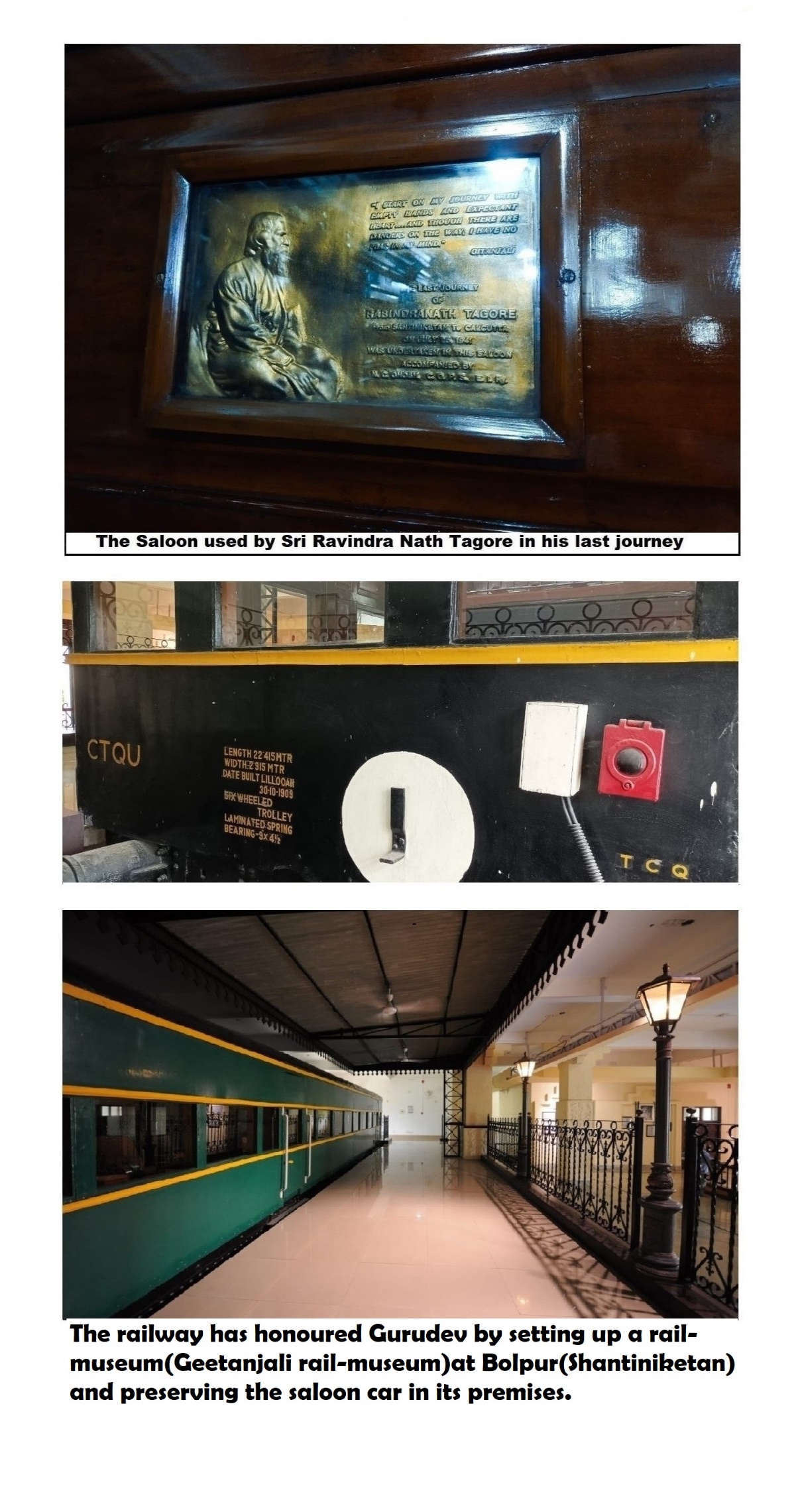
25th July 1941 was a solemn morning as the ailing Gurudev left Shantiniketan ,the ‘Abode of peace’ for the last time amidst valedictory prayer of its inmates.
“Which door this day opened?
To which name this dawn was written?”
The Gurudev also left behind fond memories of seventy years of his association with this institution. To make his train journey to Howrah agreeable the Railway had arranged a special saloon car. But the visionary perhaps had a premonition of his fate that he would never return again. Sri N.C.Ghosh, then Chief Operating Superintendent of the East Indian Railway had the distinction of accompanying the Nobel laureate in his last journey. A brass plaque fitted on the inside panel bears testimony to the historic journey.
Mayapur ISCON temple—The Chandrodaya temple here is the headquarters of ISCON (International Society of Krishna Consciousness). This spiritual town flows with devotion. The vibes produced by the greenery, simplicity and serenity of the temple complex brings about healing experience.
Dakshineshwar Kali temple—It is a revered temple located on the eastern bank of Hooghly river near Vivekanand setu. The 3 storey temple stands on a high platform with a fleet of stairs. The whole complex is neat, clean and spacious. Also, there is no nuisance from touts and vendors of puja materials. The renowned Belur math is situated on the opposite bank of the river.
Ganga Sagar-- On the eve of Makar Sankranti swathe of people largely from Bihar & UP congregate at Kolkata and proceed on specially equipped buses on way to Ganga Sagar. Ferry service for crossing Hooghly to reach Sagar island is available at Harwood point approachable by road from Kolkata and at Bakkhali approachable from Namkhana railway station. Some businessmen used to erect pandals on the Strand road for accommodating the tourists during transit. The state government put up considerable effort looking after security arrangements, healthcare and fire safety. Even one year there was a disaster when a ferry carrying the tourists sank while on its way to Sagar causing loss of hundreds of lives. Our journey to this place was in the month of August. Starting the journey in a car from Calcutta along the Diamond Harbour road we arrived at Harwood point where a ferry service took us to Kachuberia at the northern tip of Sagar island.
Onward journey to Gangasagar at the southern tip of the island was covered by road. The Sagar island of the Sunderbans flanked by the eastern and the western channels of Hooghly river faces Bay of Bengal in the south. The original Kapil Muni temple was washed away by the sea. An attractive new temple has taken its place.
Digha sea beach-- A trip to the scenic Digha sea beach from Kolkata by road was worth the trouble. There was no rail link although the new station building was ready to receive the proposed Tamluk-Digha rail line. Digha is one of the widest sea beaches famous for its vast shoreline and gentle waves.
The superannuation- On a couple of occasions I had the chance of conducting trolley inspection with my brother-in-law who was then posted as PWI, Danapur . But for the period of inspection our relationship remained impersonal while we both shared a vision of a trustworthy track. There were some apprehensive moments in my trolley inspections in the past, yet mercifully I had come out unscathed. But the luck was not on my side in the last year of my railway service. Six months before my superannuation my motor trolley met with an accident on a points and crossing near Chiraiyatand bridge, Patna . In consequence thereof I suffered bone fracture of my left hand and taken to Danapur railway hospital where the bone was set right after administering anesthesia and the hand plastered. For the first time in my railway service I made use of my LHAP.
In the year of my superannuation (1997) bungalow no 10, Belvedere Park was under my occupation. There were about a dozen duplex type bungalows in the railway settlement here including the one occupied by an official of the National Test House, Alipur located next to it. There was a distinguished club and an attached VIP rest house in the complex. The Agri-horticultural society park was located opposite the main gate of the railway colony and the post office opposite the subsidiary gate. The tram line for Kalighat passed through the road to which the subsidiary gate opened. It was a convenient mode of transport for visit to Deshpriya park, Priya cinema and Gariahaat on Rash Behari avenue. Sri Sharat Kumar Sinha my ex colleague at Mughalsarai some twenty years ago lived nearby in the railway’s tower at judges Court road.
A few months before superannuation recovery of the PF was stopped. A thick book given to me which I had to fill in with details of post retirement address, family details, bank from where I would like to draw my pension etc. Foregoing my last month salary, I opted for RELHS (Retired Employee Liberalized Health Scheme) by virtue of which I am entitled for medical treatment in Railway hospitals at par with the serving railway employee. The medical facility was to be availed at Danapur railway hospital as per my request. For issue of complimentary pass (3 sets in a calendar year) I preferred the office of DRM/Danapur. In the concluding month I visited Danapur division and Malda division to bid good bye to my colleagues. The two great lessons learnt during my railway service:-
(A) In the matter of expenditure, in case of doubt, seek Finance’s concurrence.
It is for the Finance to say that it is not required.
(B) In the matter of safety, in case of doubt, seek CRS’ sanction.
It is for him to say that it is not required.


 .
.
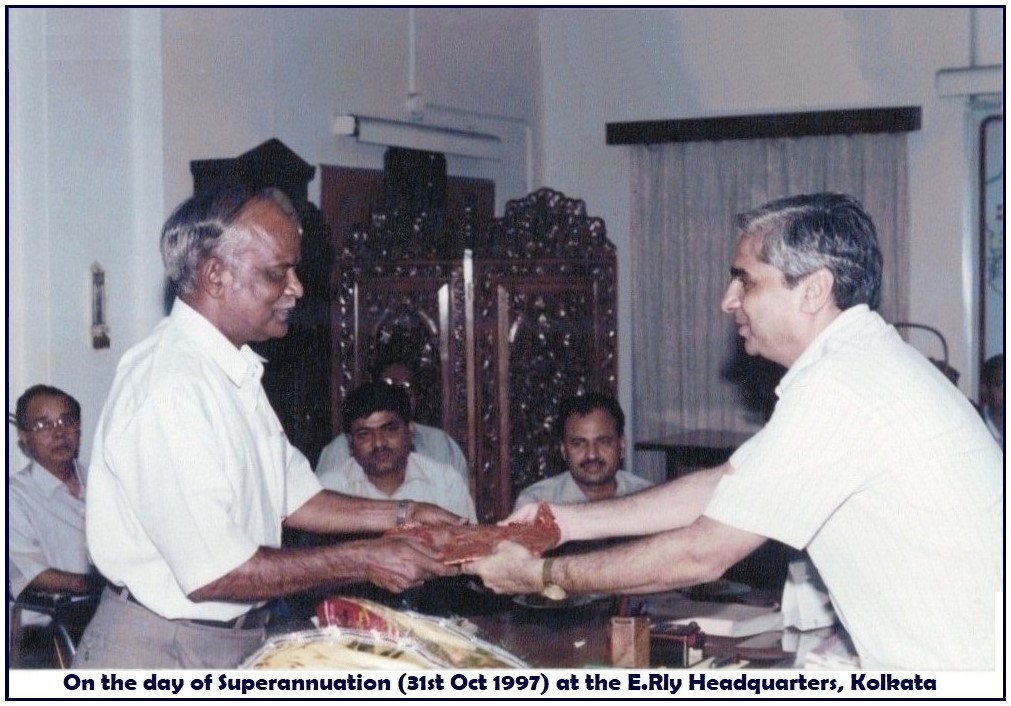
The farewell - It was arranged on 31.10.1997 at the Eastern Railway headquarters at 17, NetaJi Subhash road, Kolkata ,attended to by Son-in-law and younger daughter also. Photographer from the Chief Public Relation Officer/Eastern Railway had reported to capture the moment with his camera.

I had started my career on the railway as probationer on the South Eastern Railway, Garden Reach, Calcutta on 29th July 1963 and bade farewell to this august organization on 31st of October 1997 at the Eastern Railway Headquarters ,Calcutta itself. The end of the prestigious railway service period brought conflicting emotions in me. It was hard to say good bye to my colleagues and sign out for the last time.
From humble beginnings to senior roles I have witnessed the evolution of the Indian Railways as under:-
|
Description |
Status in 1963 |
Status in 1997 |
|
Market share of traffic |
About 80 percent |
About 20 percent |
|
Originating revenue earning freight traffic |
180 million tonne |
430. million tonne |
|
Payload/tare ratio |
Small |
Large |
|
Trailing load |
2240 MT 70 four wheelers |
4500 MT 56 eight wheelers |
|
Rail section |
90 lbs per yard 52 kg per metre |
52 kg per metre 60 kg per metre |
|
Rail lengths |
Ordinary rails-42 ft & 13m and Panel rails- 39 m with fish-plated joints |
Long Welded Rails ( 1 km) with specially designed joints |
|
Maxm. speed of mail/express trains |
100 Kmph |
140 Kmph |
|
Traction |
Steam, diesel and electric |
Diesel and electric |
I recall with nostalgia and pride decades of my dedicated service to the life-line of our nation , countless miles travelled and camaraderie of my colleagues. I am grateful for the experiences, lessons and friendships endowed to me, that have shaped my perspective. My Railway journey has been a defining chapter in my life and I will cherish it so long as I live.